
More details
Collapse details
Date Published:
Filesize:
- May 1, 2023
This report describes results from vessel surveys and visual species verifications conducted at the Jacksonville Shallow Water Training Range (JSWTR) in the Jacksonville Operating Area (OPAREA).
- 7,883.00 KB
More details
Collapse details
Date Published:
Filesize:
- May 1, 2022
This report describes results of vessel surveys from a multi-institutional monitoring project intended to provide information on the species composition, population identity, density, and baseline behavior of marine mammals and sea turtles present in United States (U.S.) Navy range complexes along the U.S. Atlantic Coast.
- 10,366.95 KB
More details
Collapse details
Date Published:
Filesize:
- March 1, 2015
The HDR Monitoring Team is tasked to initiate a monitoring project that will provide quantitative data and information on the seasonal occurrence, distribution, and density of protected species (marine mammals and sea turtles) in Chesapeake Bay waters near Naval Air Station (NAS) Patuxent (PAX) River, roughly from Drum Point, south to Smith Point along the western shore and over to the coastal waters of the eastern shore.
- 1,163.40 KB
Evidence of pier fidelity in hooked and released loggerhead and Kemp's ridley sea turtles using acoustic and satellite telemetry.
3rd Southeast Regional Sea Turtle Meeting (SERSTM) .
Unique morphological and acoustic characteristics of beaked whales (Mesoplodon sp.) off the west coast of Baja California, Mexico.
Marine Mammal Science. 2021.
38:383–390
More details
Collapse details
Date Published:
Publication:Ocean:Region:Methods:
- July 1, 2021
Unique morphological and acoustic characteristics of beaked whales (Mesoplodon sp.) off the west coast of Baja California, Mexico
More details
Collapse details
Date Published:
Filesize:
- September 13, 2013
This ongoing project will study explosions recorded by passive acoustic monitoring in the Southern California (SOCAL) region between 2009 and 2012, and provide a description of their characteristics and frequency of occurrence. In this region, explosions are used both by the Navy as part of training exercises, and by the commercial fishing industry as a deterrent for marine mammals
- 1,230.02 KB
Diel and lunar variations of marine ambient sound in the North Pacific.
162nd Meeting: Acoustical Society of America .
More details
Collapse details
Date Published:
Filesize:
- November 3, 2011
Marine ambient sound was recorded on autonomous high-frequency acoustic recording packages (bandwidth 10 Hz to 100 kHz) during long term deployments at multiple sites across the North Pacific, from the high latitude Aleutian Islands to tropical Palmyra Atoll in depths of 600–1 000 m. Most intertropical but no temperate locations showed a distinct diel pattern in ambient sound. The soundscape at each location was unique, yet there was a similar recurring sound of unknown origin in lower latitude locations. This sound had a peak frequency around 3–5 kHz and was recorded only for several hours after sunset. Additionally, at some locations, a broadband acoustic signal with bandwidth up to 60 kHz was recorded at night with crepuscular peaks. Both sound patterns were lunar dependent with lower acoustic levels during full moon phases. Site-specific diel and seasonal acoustic patterns have been observed for various odontocete species. Correlations between odontocete presence and levels of ambient sound are investigated. [Work supported by NOAA-Pacific Islands Fisheries Science Center, US Navy-N45/PACFLT, ONR, Pacific Life, Ocean Foundation, University of California, San Diego.]
- 43.94 KB
More details
Collapse details
Date Published:
Filesize:
- January 3, 2023
For the last five months, Dr. Will Gough has been working at the Marine Mammal Research Program (MMRP) on a number of goals that will build capacity within Hawaii and advance the Navy’s goals related to the long-term health of protected marine mammal species. These goals relate to Dr. Gough’s expertise working with accelerometry-based biologging tags and include: setting up infrastructure at the MMRP to maintain large quantities of tag data, collecting novel data and expanding existing datasets through field efforts, training members of the Navy and MMRP to work effectively with accelerometry data and biologging devices, develop training materials and short-form workshops to disseminate knowledge of accelerometry data processing and analysis more broadly within the Hawaiian community, and use new and existing datasets to answer questions of relevance to the Navy and other organizations tasked with monitoring and management of protected species.
- 220.81 KB
U.S. Navy Integrated Comprehensive Monitoring Program.
19th Biennial Conference on the Biology of Marine Mammals .
More details
Collapse details
Date Published:
Filesize:
- November 27, 2011
The Integrated Comprehensive Monitoring Program (ICMP) provides an overarching framework for coordination of U.S. Navy marine species monitoring. It is intended for use as a planning tool to focus Navy monitoring priorities pursuant to ESA and MMPA requirements and as an adaptive management tool to analyze and refine monitoring and mitigation techniques over time. It has been developed in direct response to Navy Range permitting requirements established in the various MMPA Final Rules, ESA consultations, and other applicable regulations. In early 2011 the Navy established a Scientific Advisory Group (SAG) consisting of experts in marine mammal ecology, passive acoustic monitoring, and cetacean behavior. The Navy convened the SAG with the initial task of evaluating current monitoring approaches under the ICMP and existing Letters of Authorization and developing objective scientific recommendations that will serve as the basis for a Strategic Plan for Navy monitoring. The Strategic Plan will be integrated as a primary component of the ICMP and provide a comprehensive 3-5 year “vision” for Navy monitoring across geographic regions - serving as guidance for determining how to most efficiently and effectively invest the U.S. Fleet marine species monitoring budget to address ICMP objectives and satisfy Marine Mammal Protection Act Letter of Authorization regulatory requirements for Fleet testing and training activities.
- 169.53 KB
U.S. Navy Marine Mammal Compliance and Mitigation Program in the Atlantic: A review.
21st Biennial Conference on the Biology of Marine Mammals .
More details
Collapse details
Date Published:
Filesize:
- December 13, 2015
The U.S. Navy's Atlantic Fleet conducts training and testing activities within the Northwest Atlantic Ocean and Gulf of Mexico, including the use of active sonar and explosives. While training and testing activities have the potential to impact the environment, the Navy employs every means available, without jeopardizing the safety of Sailors or impacting military readiness, to mitigate the potential environmental effects of these activities. Prior to training and testing activities, the Navy consults extensively with environmental regulators to determine appropriate mitigations to protect marine species, particularly marine mammals. Additionally, in order to evaluate the impacts of Navy activities on marine mammals and other protected species, the Navy has implemented a monitoring program to collect data on baseline animal presence, as well as exposure and response to Navy training and testing activities. Passive acoustic monitoring remains a cornerstone of addressing revised long term objectives of the monitoring program, and continues to provide key data on marine mammal presence and behavior. Future work will focus on species classification and animal behavior before, during, and after exposure to potential stressors. This presentation will provide an overview of Navy environmental compliance in the Atlantic, including monitoring efforts. This presentation will also discuss the tools and processes that Navy uses to assess the potential impacts of activities, how mitigation is used to reduce those impacts, and protective measures such as the restrictions employed in the North Atlantic right whale critical habitat areas. The Navy remains committed to marine stewardship and responsible management of the potential impacts of training and testing activities on protected species.
- 91.18 KB
U.S. environmental compliance and conservation efforts for sea turtles in the Atlantic and Gulf of Mexico.
NOAA technical memorandum NMFS PIFSC. 2013.
38-39
More details
Collapse details
Date Published:
Filesize:
- July 2, 2013
Environmental stewardship is an integral part of the Navy's mission. It protects and preserves the capabilities of training areas, ensures operational flexibility, and sustains the resources and public support needed to carry out the Navy's mission. The Navy is responsible for compliance with a suite of environmental and natural resources laws and regulations that apply to the marine environment, and in particular, to sea turtles. To comply with these mandates, the Navy works closely with regulatory agencies and must be able to properly evaluate the impacts of at-sea training activities on protected species. In order to institute efforts to minimize these impacts there must be: I) the best available data on the density and distribution of the species in question; 2) the criteria necessary to assess impacts; and 3) the creation of the practical mitigation measures. To meet these objectives, the Navy developed the Navy Marine Species Density Database (NMSDD) which documents density estimates for all sea turtle populations where the Navy primarily trains in the Atlantic Ocean and Gulf of Mexico. The Navy also established an initial set of quantitative criteria for assessing acoustic impact to sea turtles from sonar and explosives. These data are utilized in regulatory compliance documents to support quantitative modeling and qualitative assessments of the potential impacts of a variety of Navy stressors on sea turtles and their habitats, including but not limited to the use of sonar, explosives, and military expended materials. Additionally, the Navy employs mitigation measures both at-sea and on Navy installations to minimize the impacts of Navy activities on sea turtles and to promote conservation of their populations. Some of these measures include monitoring sea turtle nests on Navy beaches during the nesting season, having trained lookouts to observe mitigation zones during at-sea training activities to minimize potential effects to sea turtles, and conducting or funding sea turtle research to reduce knowledge gaps. The Navy continues to be a leader in environmental stewardship and utilize the best technology and techniques to improve our compliance and conservation efforts with respect to sea turtle populations. However, deficiencies in the amount or quality of data available, as well as access to research, can significantly limit the Navy's ability to assess and mitigate impacts. As a result, the Navy plans to improve partnerships with international, federal, state, and local agencies; public and private organizations; and academic institutions by engaging stakeholders to maximize our effectiveness in addressing environmental issues.
- 762.70 KB
More details
Collapse details
Date Published:
Filesize:
- June 20, 2018
Coral reef surveys were conducted at Farallon de Medinilla (FDM) September 27 – October 1, 2017 by Space and Naval Warfare (SPAWAR) Systems Center Pacific, Scientific Diving Services (SDS) to satisfy requirements of the Mariana Islands Training and Testing Area Biological Opinion (MITT BO) issued by the National Marine Fisheries Service in 2015 (NMFS 2015). The primary objectives of this survey were to quantify the abundance and location around the island of Endangered Species Act (ESA)-listed corals, quantify coral reef health (percent cover of living coral, coral species composition, and coral condition), and compile observations of ordnance impacts
- 7,446.41 KB
More details
Collapse details
Date Published:
Filesize:
- October 1, 2018
Coral reef surveys were conducted at Farallon de Medinilla (FDM) September 27 – October 1, 2017 by Space and Naval Warfare Systems Center Pacific (SSC Pacific), Scientific Diving Services (SDS) to satisfy requirements of the Mariana Islands Training and Testing Area Biological Opinion (MITT BO) issued by the National Marine Fisheries Service in 2015 (NMFS 2015). Two reports have been produced, based upon the field data obtained. The first report, entitled “Farallon De Medinilla 2017 Coral Reef Survey Report,” is dated May 2018 (Carilli et al. 2018). This document should be regarded as the second report of the 2017 survey results
- 6,300.50 KB
Coral bleaching variability during the 2017 global bleaching event on a remote, uninhabited island in the western Pacific: Farallon de Medinilla, Commonwealth of the Northern Mariana Islands.
Bulletin of Marine Science. 2020.
96(4), 785-802
More details
Collapse details
Date Published:
- January 1, 2020
Spatial and temporal separation of toothed whales in the western North Atlantic.
Marine Ecology Progress. 2023.
720:1-24
More details
Collapse details
Date Published:
Publication:Ocean:Region:Methods:
- January 1, 2023
A diverse group of toothed whale species inhabits the pelagic habitats of the western North Atlantic, competing for overlapping prey resources. Historical data deficits have limited fundamental research into many of these species, such as establishing baselines of distribution and abundance, so their occurrence and habitat use patterns are not well characterized. Periodic cycles in activity have been reported at a range of temporal scales for odontocetes in other regions, such as seasonal movements, foraging activity modulated by lunar cycles, and diel activity patterns. A variety of spatial, temporal, and behavioral separation strategies have also been observed among predator guilds in both marine and terrestrial systems, and these may also contribute to observed spatiotemporal patterns in activity. Recently, passive acoustic data has been applied to monitor odontocete species continuously, with improved detection and species discrimination for some cryptic species. We used a long-term passive acoustic data set collected at sites spanning the western North Atlantic shelf-break region to quantify presence and characterize seasonal, lunar, and diel activity patterns for 10 species. Our results demonstrated strong regional preferences and clear patterns of spatiotemporal separation between species with similar foraging ecology. Latitudinal shifts in seasonal presence peaks may suggest meridional seasonal migrations for some dolphin species. We also observed strong diel activity patterns that were modulated by both seasonal and lunar cycles. This study reveals complex behavioral patterns arising in response to natural cycles playing out over multiple temporal scales and provides new insights into habitat partitioning among toothed whale species.
More details
Collapse details
Date Published:
Filesize:
- April 7, 2017
This report provides equations to the Commander, Pacific Fleet Environmental Readiness Division to calculate expected levels of the underwater sound field created from explosive sources that may be applied to environmental characterization or UNDET training mission planning on the Pu`uloa Range with respect to possible noise exposure to marine mammals and turtles.
- 2,125.59 KB
A hand-held tool for rapid assessment of underwater sound to inform decision making.
21st Biennial Conference on the Biology of Marine Mammals .
More details
Collapse details
Date Published:
Filesize:
- December 13, 2015
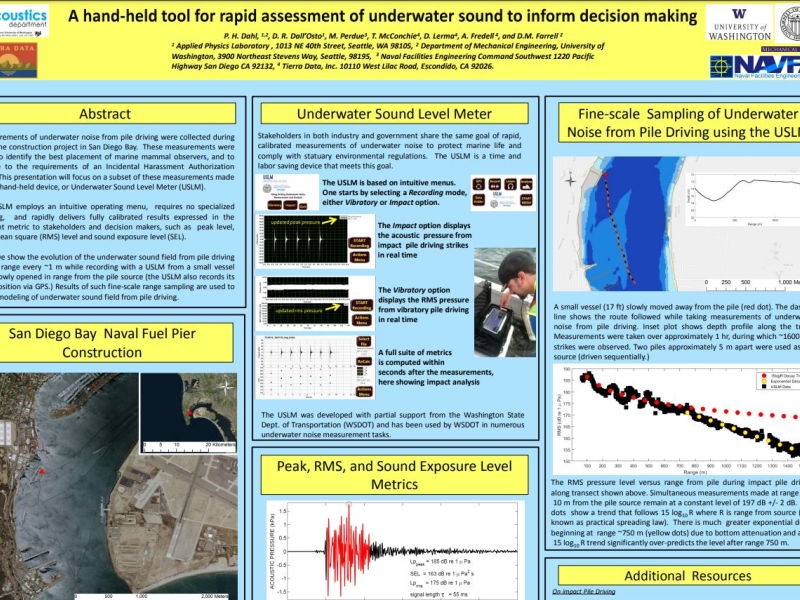
Measurements of underwater noise from pile driving have been collected in San Diego Bay during a marine construction project, to inform placement of marine mammal observers, and adhere to Incidental Harassment Authorization (IHA) requirements. This presentation will focus on a subset of these measurements made with a hand-held device, or Underwater Sound Level Meter (USLM). The USLM employs an intuitive operating menu, requires no specialized training, and rapidly delivers fully calibrated results expressed in the relevant metric, such as peak level, rms level and sound exposure level. Several examples will be discussed involving the documentation of isopleths associated with the 190 dB and 180 dB isopleths (rms level, dB re 1 µPa) that define Level A injury thresholds for pinnipeds and cetaceans, respectively. One represents a unique set of measurements made during which the USLM documented the evolution of the underwater sound field from impact pile driving versus range every approximately 5 m. This made possible by recording from a small vessel that slowly opened in range from the pile source (the USLM also records its own position via GPS. ) The results of such fine-scale range sampling are also compared with modeling of transmission loss with range from the pile. Stakeholders in both industry and government share the same goal of rapid, calibrated measurements of underwater noise to protect marine life and comply with statuary environmental regulations. The USLM is a time and labor saving device that meets this goal.
- 91.71 KB
More details
Collapse details
Date Published:
Filesize:
- January 1, 2011
The project’s goal is analysis of passive acoustic monitoring recordings that were obtained by scientists at Hawaii Institute of Marine Biology (HIMB) using Ecological Acoustic Recorders (EAR) devices. The information to be extracted from the recordings is on the presence of marine mammals and the nature of the sounds they make. Some of these historical recordings from 2009 and 2010 coincide with Naval training events in the areas around the islands of Oahu and Kauai. In optimal situations, analysis of days of recordings from a few days before, during, and a few days after the training events were available to characterize the baseline environmental acoustic state before and after events as well as any changes that may occur during events
- 360.57 KB
More details
Collapse details
Date Published:
Filesize:
- January 1, 2012
The U. S. Navy (Navy) has developed this Mariana Islands Range Complex (MIRC) Monitoring Plan to provide marine mammal and sea turtle monitoring as required under the Marine Mammal Protection Act (MMPA) of 1972 and the Endangered Species Act (ESA) of 1973. In order to issue an Incidental Take Authorization (ITA) for an activity, Section 101(a)(5)(a) of the MMPA states that National Marine Fisheries Service (NMFS) must set forth “requirements pertaining to the monitoring and reporting of such taking.” The MMPA implementing regulations in 50 CFR Section 216.104 (a)(13) note that requests for Letters of Authorization (LOAs) must include the suggested means of accomplishing the necessary monitoring and reporting that will result in increased knowledge of the species and of the level of taking or effects to populations of marine mammals that are expected to be present.
- 510.53 KB
More details
Collapse details
Date Published:
Filesize:
- October 1, 2012
For August 2012 through August 2013, the U.S. Navy proposes to keep the same level of monitoring effort in the Southern California Range Complex as was committed to and accomplished annually previously from 2011-2012 (DoN 20111).
- 324.76 KB
More details
Collapse details
Date Published:
Filesize:
- January 15, 2015
In order to train with mid-frequency active sonar (MFAS) and underwater explosives, the Navy has obtained from the National Marine Fisheries Service (NMFS) a Letter of Authorization (LOA) under the Marine Mammal Protection Act (MMPA) and a Biological Opinion under the Endangered Species Act.
- 350.57 KB
Sitka WhaleFest, Sitka Sound Science Center, November 2-5, 2023, Sitka, Alaska .
More details
Collapse details
More details
Collapse details
Date Published:
Filesize:
- October 1, 2010
In order to train with mid-frequency active sonar (MFAS), the Navy has obtained a permit from the National Marine Fisheries Service (NMFS) under the Marine Mammal Protection Act and Endangered Species Act. The Hawaii Range Complex (HRC) Monitoring Plan, finalized in December 2008 for implementation in January 2009, was developed with NMFS to comply with the requirements under the permit. The monitoring plan and reporting will provide science-based answers to questions regarding whether or not marine mammals are exposed and reacting to Navy MFAS.
- 485.14 KB
Modeling of zones of influence and ambient noise metrics to inform decision making.
21st Biennial Conference on the Biology of Marine Mammals .
More details
Collapse details
Date Published:
Filesize:
- December 13, 2015
Measurements of underwater noise from pile driving were collected in San Diego Bay during a marine construction project to inform placement of marine mammal observers, and adhere to Incidental Harassment Authorization (IHA) requirements. This work presents the modeling of Zones of Influence (ZOIs) for pile driving noise as well as results from ambient noise monitoring. Results from real-time monitoring showed good agreement with the modeling isopleths associated with the 190 dB and 180 dB isopleths (rms level, dB re 1 µPa) that define Level A injury thresholds for pinnipeds and cetaceans, respectively. Ambient noise measurements were also collected in the bay; we evaluate the L10, L50 and L90 exceedance levels (where Lx means these values were exceeded x% of the time) from a regulatory standpoint.
- 91.82 KB
Ecological inferences about marine mammals from passive acoustic data.
Biological Reviews. 2023.
98:1633–1647
More details
Collapse details
Date Published:
Publication:Methods:
- May 4, 2023
Monitoring on the basis of sound recordings, or passive acoustic monitoring, can complement or serve as an alternative to real-time visual or aural monitoring of marine mammals and other animals by human observers. Passive acoustic data can support the estimation of common, individual-level ecological metrics, such as presence, detection-weighted occupancy, abundance and density, population viability and structure, and behaviour. Passive acoustic data also can support estimation of some community-level metrics, such as species richness and composition. The feasibility of estimation and certainty of estimates is highly context dependent, and understanding the factors that affect the reliability of measurements is useful for those considering whether to use passive acoustic data. Here, we review basic concepts and methods of passive acoustic sampling in marine systems that often are applicable to marine mammal research and conservation. Our ultimate aim is to facilitate collaboration among ecologists, bioacousticians, and data analysts.
More details
Collapse details
Date Published:
Publication:Ocean:Region:Methods:
- May 13, 2025
Passive acoustic monitoring (PAM) is a key technology for studying marine mammal populations. PAM typically generates large volumes of data that contain signals from multiple overlapping sources. To extract meaningful information from these data, automated tools are required that can cope with multiple sources, missed detections, and false alarms. This paper presents the Multiple-Animal Model-Based Acoustic Tracking (MAMBAT) framework, which integrates model-based localization with Bayesian multi-target tracking to automatically track multiple sound sources using acoustic data from wide baseline arrays. MAMBAT leverages a “Track-before-Localize” strategy followed by a “Localize-then-Track” strategy that does not require detection, classification, or association steps. The framework’s effectiveness is demonstrated through application to real-world datasets that contain multiple sperm whales from two ocean basins. MAMBAT advances our ability to monitor marine mammal distribution, abundance, and behavior, with potential to provide valuable information for conservation and management efforts.
Navy Living Marine Resources Meeting, Santa Barbara, California. November 2023 .
More details
Collapse details
SMART SEED Annual Review. Tysons, Virginia .
Oral Presentation, Effects of Sound on Marine Mammals, Beaufort, North Carolina, 15-18 March 2022 .
More details
Collapse details
Date Published:
- March 15, 2022
Marine mammals and sonar: Dose-response studies, the risk-disturbance hypothesis and the role of exposure context.
Journal of Applied Ecology. 2017.
55:396-404
More details
Collapse details
Date Published:
Publication:Methods:
- June 19, 2017
Behavioural response studies have greatly improved our understanding of the potential effects of naval sonar on marine mammals. Despite data gaps, we believe a dose-response approach within a risk-disturbance framework will enhance our ability to predict responsiveness for unstudied species and populations. We advocate for (1) regulatory frameworks to utilize peer-reviewed research findings when making predictions of impact, (2) regulatory frameworks to account for the inherent uncertainty in predictions of impact and (3) investment in monitoring programmes that are both directed by recent research and offer opportunities for validation of predictions at the individual and population level.
More details
Collapse details
Date Published:
Filesize:
- February 1, 2012
In September of 2011, four passive acoustic monitoring devices were deployed in the Marianas Island Range Complex (MIRC). These Ecological Acoustic Recorders, or “EARs”, were developed by Marc Lammers and Whit Au at the University of Hawai’i/Hawai’i Institute of Marine Biology. The dates, locations, and deployments depths for the four instruments are summarized in Table 1. Deployments were made to the northwest and southwest of Guam, one to the north off Saipan, and one to the southwest of Tinian.
- 320.24 KB
More details
Collapse details
Date Published:
Filesize:
- April 1, 2013
A working group of experts (i.e., biologists, acousticians, and other researchers with extensive experience working in the Hawaii Range Complex [HRC]) was convened in San Diego, California, for an HRC Data Analysis Planning Meeting on 10 and 11 September 2012. The purpose of the meeting was to assess how existing HRC monitoring data can be used to support the United States (U.S.) Pacific Fleet’s regulatory requirements to determine the: 1) presence/absence, abundance, and density of marine mammals and sea turtles in the HRC; and 2) behavioral responses of marine mammals and sea turtles to U.S. Navy training exercises, including mid-frequency active sonar and underwater detonations.
- 499.18 KB
The 9th International Workshop on Detection, Classification, Localization, And Density Estimation of Marine Mammals Using Passive Acoustics, Honolulu, Hawaii, 7–11 March 2022 .
More details
Collapse details
Beaked Whale Behavioral Responses to Navy Mid-Frequency Active Sonar.
Springer Cham. 2023.
Living reference work entry
More details
Collapse details
Date Published:
Publication:Ocean:Methods:
- August 22, 2023
Although beaked whales remain a cryptic and elusive family, much has been learned about their dive and foraging behavior in the last few decades through the use of passive acoustic monitoring (PAM) and a variety of tagging methods. Species-specific echolocation pulses can be used to acoustically track individuals and groups, and biologging tags provide information on dive and movement behavior. These technologies have also provided a window into how beaked whales behaviorally respond to Navy mid-frequency active sonar, which in turn may elucidate maladaptive behaviors that could lead to stranding. This chapter reviews existing knowledge about beaked whale behavioral responses to anthropogenic sound sources in general, and to Navy sonars in particular. By understanding the breadth of ways beaked whales behaviorally respond, the scientific community can continue to work toward recognizing and mitigating responses that could lead to stranding, as well as determining the population-level implications of impacts on individuals.
Navy Marine Species Monitoring Meeting, San Diego, California, April 2022 .
More details
Collapse details
The Effects of Noise on Aquatic Life, Berlin, Germany, 10-15 July 2022 .
More details
Collapse details
Date Published:
Filesize:
- October 1, 2020
The 2018 California Current Ecosystem Survey (CCES) was a joint project of the Marine Mammal and Turtle Division (MMTD) and the Fisheries Resources Division (FRD) of National Oceanographic and Atmospheric Administration’s (NOAA) Southwest Fisheries Science Center (SWFSC). The survey was conducted over the course of 7 legs aboard the NOAA ship Reuben Lasker between 26 June and 4 December 2018 (Table 1). CCES was an assessment survey for coastal pelagic fish stocks, marine mammals, seabirds, and oceanography along the west coasts of southern Canada (Vancouver Island), US, and northern Mexico (Baja California), out to a distance of approximately 200 nautical miles offshore (Fig. 1). MMTD and FRD worked jointly aboard the vessel during Legs 1 through 4 (OMAO Project No. RL-18-03) (Tables 1, 2a, and 2b), during which the vessel surveyed off the coasts of Vancouver Island and the US West Coast. Only MMTD operations were conducted during Legs 5 through 7 (OMAO Project No. RL-19- 01), during which the vessel surveyed off the US West Coast and Mexico. This document covers the work conducted by MMTD (MMTD Survey No. 1651). Work conducted by FRD is presented separately (Stierhoff et al. 2019).
- 3,239.97 KB
Time-discretization approximation enriches continuous-time discrete-space models for animal movement.
Annals of Applied Statistics. 2023.
17(1):740–760
More details
Collapse details
Date Published:
Publication:Ocean:Region:
- March 1, 2023
Continuous time discrete state models are a valuable tool for explaining animal movement. However, data collection to fit such models over a specified window of time can be misaligned with the actual realization of the movement process. This necessitates approximate model fitting, at present, through approximate imputation distributions (AIDs). Here, we propose a direct time-discretization approximation to the likelihood.
More details
Collapse details
Date Published:
Filesize:
- February 1, 2016
The primary objectives of the passive acoustic 26 monitoring program are to: 1) Determine the patterns of occurrence at each monitoring site; 2) Compare patterns of occurrence to better understand distributional patterns; and 3) Document species-specific characteristics of the vocalizations of marine mammal species 30 in each area.
- 9,348.40 KB
Source levels and spectral characteristics of sound produced during pile driving at US East Coast Navy Installations.
4th International Conference on the Effects of Noise on Aquatic Life .
More details
Collapse details
Date Published:
- July 10, 2016
- 2,143.89 KB
More details
Collapse details
Date Published:
Ocean:
- January 1, 2025
Statistical Analysis of Marine Mammal Stranding Events
More details
Collapse details
Date Published:
Filesize:
- January 1, 2017
In order to better assess the impacts of pile-driving activities, the U.S. Navy has collected data at six locations where 93 pile driving events occurred in which noise levels were measured over a 3-year period of airborne and underwater empirical acoustic noise-level data collected during pile-driving construction projects along the Mid-Atlantic corridor.
- 10,612.93 KB
More details
Collapse details
Date Published:
Filesize:
- August 29, 2013
This report summarizes the hydroacoustic monitoring results for sheet piles and H-Piles at the Joint Expeditionary Force Base Little Creek and 24-inch concrete pile at Craney Island near Naval Station Norfolk in Norfolk, Virginia. The plan was to measure sheet piles on 28 and 30 May and measure concrete piles driven on 29 May.
- 7,233.17 KB
More details
Collapse details
Date Published:
Filesize:
- February 1, 2015
This report summarizes the underwater and airborne noise monitoring results for impact driving 24-inch (61 centimeter) square concrete piles and vibratory driving timber piles at the Naval Station Norfolk in Norfolk, Virginia
- 1,386.24 KB
More details
Collapse details
Date Published:
Filesize:
- August 1, 2015
This report summarizes underwater and airborne acoustic monitoring results for pile-driving at Naval Station Mayport in Jacksonville, Florida during through 11 June 2015. Both 96.5- centimeter (cm) (38-inch [in]) × 45.7-cm (18-in) king piles and 122-cm (48-in) sheet piles were installed.
- 2,294.67 KB
More details
Collapse details
Date Published:
Filesize:
- January 1, 2015
This report summarizes the underwater and airborne noise monitoring results for (36-inch [91.4 cm] and 48-inch [121.2 cm]) steel shell piles at the Philadelphia Naval Shipyard Annex in Philadelphia, Pennsylvania (Figure 1). The piles driven were structural piles being driven to reinforce the existing Pier
- 3,630.10 KB
More details
Collapse details
Date Published:
Filesize:
- December 1, 2015
This report summarizes underwater and airborne acoustic monitoring results for removal of piles associated with the training exercise related to the removal of the Elevated Causeway (ELCAS) at Joint Expeditionary Base (JEB) Little Creek, Norfolk, Virginia. On 10 and 11 September 2015, multiple 61-centimeter diameter (24-inch) steel pipe piles were removed. All pile-extractions were accomplished using an APE 150 Vibratory Driver Extractor; which has an eccentric moment of 23.35 kilogram-force-meter (2,200 pound-force inch). Noise levels were measured for 13 piles
- 3,803.29 KB
More details
Collapse details
Date Published:
Filesize:
- November 1, 2016
This report summarizes underwater and airborne acoustic monitoring results for the installation of piles associated with the training exercise related to the construction of the Elevated Causeway (ELCAS) at Joint Expeditionary Base (JEB) Little Creek, Norfolk, Virginia. On 26, 27, and 28 April 2016, multiple 24-inch (61-centimeter) diameter steel pipe piles were installed.
- 1,941.09 KB
The characteristics of dolphin clicks compared across recording depths and instruments.
Journal of the Acoustical Society of America. 2016.
139(4,Part 2):3131
More details
Collapse details
Date Published:
Publication:Ocean:Region:Methods:
- October 1, 2016
The identification of delphinid species on the basis of the characteristics of their acoustic signals is an important aspect of many passive acoustic monitoring efforts. The development of species classifiers relies on the assumption that species-specific signal characteristics will be consistent across different recording scenarios, including depth and instrumentation. However, this assumption has largely remained untested. Here, we report on an effort to examine whether and how the properties of echolocation clicks obtained from different delphinid species vary as a function of recording depth and the instrument employed. Field recordings of seven species of dolphins were obtained off Kona, Hawaii, and San Diego, CA, using a 250 m vessel-based vertical array composed of five microMARS recorders, two SoundTrap recorders, and four C75 broadband dipping hydrophones (Cetacean Research Technology). The clicks obtained were characterized on the basis of their spectral properties and duration for each recording depth and also compared among different instruments deployed at the same depth. Both depth and recording instrumentation influenced the click characteristics observed. However, the click properties of some species varied to a greater degree than others. These results suggest that developing species-specific classifiers based on dolphin clicks should be approached with caution and carefully validated.
Investigating the response of coastal dolphins to mine exercise (MINEX) training activities.
Watkins Memorial Marine Mammal Bioacoustics Symposium .
More details
Collapse details
Date Published:
Filesize:
- March 26, 2015
Mine detonation exercises in coastal waters have the potential to disturb, injure or even kill marine mammals occurring in the same area. To address concerns about this possibility at the U.S. Navy’s Virginia Capes (VACAPES) Range Complex, an effort was begun in August 2012 to monitor odontocete activity at the mine exercise (MINEX) training range using passive acoustic methods. The objectives of the project were to establish the daily and seasonal patterns of occurrence of dolphins in the VACAPES MINEX training area, to detect explosions related to MINEX activities, and to determine whether dolphins in the area show evidence of a response to MINEX events. Data from moored recorders were analyzed for the daily presence/absence of dolphins and their acoustic activity was quantified in detail for the period prior, during and after MINEX activities, as well as at various distances from the training site. The results reveal that dolphins exhibit a short-term acoustic response immediately following an explosion event. Acoustic activity increases briefly and then declines substantially. There is also evidence of a decrease in overall acoustic activity lasting several hours following the exercise. Current analyses aim to establish whether the observed response represents a shift in acoustic behavior or a spatial redistribution of the animals.
- 1,874.75 KB
Investigating the response of coastal dolphins to mine exercise (MINEX) training activities.
OCEANOISE2015 .
More details
Collapse details
Date Published:
Filesize:
- May 11, 2015
The naval forces of many countries conduct mine detonation exercises in coastal waters as part of their regular training. These exercises have the potential to disturb, injure or even kill marine mammals occurring in the same area. To address concerns about this possibility at the U.S. Navy’s Virginia Capes (VACAPES) Range Complex, an effort was begun in August 2012 to monitor odontocete activity at the mine exercise (MINEX) training range using passive acoustic methods. The objectives of the project were to establish the daily and seasonal patterns of occurrence of dolphins in the VACAPES MINEX training area, to detect explosions related to MINEX activities, and to determine whether dolphins in the area show evidence of a response to MINEX events. Up to four Ecological Acoustic Recorders programmed to achieve continuous monitoring were deployed and refurbished approximately every two months. The data were analyzed for the daily presence/absence of dolphins and their acoustic activity was quantified in detail for the period prior, during and after MINEX activities, as well as at various distances from the training site. The results indicate that dolphins are present daily in or near the MINEX range, a finding that supplements limited visual survey information due to restricted regular access to the MINEX area. The data also reveal that dolphins exhibit a short-term acoustic response immediately following an explosion event. Acoustic activity increases briefly and then declines substantially. There is also evidence of a decrease in overall acoustic activity lasting several hours following the exercise. Current analyses aim to establish whether the observed response represents a shift in acoustic behavior or a spatial redistribution of the animals. These results underscore the value of long-term monitoring to inform the military on the potential impacts on marine mammal populations from training exercises involving underwater explosions.
- 1,874.75 KB
Response by coastal dolphins to naval mine exercise (MINEX) training activities off Virginia Beach, USA.
Fourth International Conference on the Effects of Noise on Aquatic Life .
More details
Collapse details
Date Published:
Filesize:
- July 10, 2016
The naval forces of many nations conduct mine detonation exercises in coastal waters as part of their regular training. These exercises have the potential to disturb, injure, or even kill marine mammals occurring in the same area. To address concerns about this possibility at the US Navy’s Virginia Capes (VACAPES) Range Complex, an effort was conducted to monitor odontocete activity at the mine exercise (MINEX) training range using passive acoustic methods. The objectives of the project were to document the daily and seasonal patterns of occurrence of dolphins in the VACAPES MINEX training area, to detect explosions related to MINEX activities, and to investigate potential behavioral and acoustic responses of dolphins to MINEX events. Up to four ecological acoustic recorders programmed to achieve continuous monitoring were deployed at various distances from the known “epicenter” of training events and were refurbished approximately every two months. Dolphins were detected near the training area year round, with ~97% of monitored days containing some dolphin acoustic signals. However, there was also clear seasonal variability, with a consistent period of low occurrence or reduced acoustic activity during the winter months.
- 479.71 KB
More details
Collapse details
Date Published:
Ocean:Region:Methods:
- March 2, 2026
The naval forces of many nations conduct mine detonation exercises in coastal waters as part of their regular training. These exercises have the potential to disturb, injure or even kill marine mammals occurring in the same area. To address concerns about this possibility at the U.S. Navy’s Virginia Capes (VACAPES) Range Complex, an effort was conducted to monitor odontocete activity at the mine exercise (MINEX) training range using passive acoustic methods. The objectives of the project were to document the daily and seasonal patterns of occurrence of dolphins in the VACAPES MINEX training area, to detect explosions related to MINEX activities, and to investigate potential behavioral and acoustic responses of dolphins to MINEX training events. Dolphins were detected almost daily in the training area. Acoustic activity levels approximately 1 km from the epicenter of training were examined for 22 events and were found to be on average lower during both the day of and the day following the event, suggesting that animals either reduced their signaling, left the area, or both.
More details
Collapse details
Date Published:
Filesize:
- February 1, 2016
The Virginia Aquarium & Marine Science Center Foundation, Inc. (VAQF) has been tasked to conduct aerial surveys for the continental shelf region off the mouth of the Chesapeake Bay within the Virginia Capes Operating Area (VACAPES OPAREA) to provide marine species monitoring services. The current study area encompasses an approximately 6,500-squarekilometer area off the coast of Virginia extending from the southern eastern shore of Virginia to the North Carolina/Virginia state border
- 533.50 KB
More details
Collapse details
Date Published:
Filesize:
- November 1, 2023
Coral reef surveys were conducted at Farallon de Medinilla (FDM) August 14–19, 2022 by Naval Information Warfare Center (NIWC) Pacific Scientific Diving Services (SDS) to satisfy requirements of the Mariana Islands Training and Testing Area Biological Opinion (MITT BO) issued by the National Marine Fisheries Service in 2020 (NMFS 2020). This report fulfills portions of Terms and Conditions (T&C) 2b and 2c of the 2020 MITT BO (NMFS 2020). T&C 2b includes the requirement for the Navy to “provide reports of any observed inwater effects (e.g., crater size, observed mortality) to corals resulting from detonations of high-explosive ordnance as they are discovered...during coral reef surveys...” T&C 2c states “The Navy shall, no less than once every five years, survey coral reef habitat around FDM within 30 m of water depth. These surveys will be structured to confirm presence or absence and abundance of Endangered Species act (ESA)-listed corals and to assess general trends in coral reef species composition, percent coral coverage, and condition (disease, predators, extent of breakage, etc.).” The primary objectives of the 2022 field survey were to quantify the abundance and location around the island of ESA-listed corals, quantify coral reef health (percent cover of living coral, coral species composition, and coral condition), and compile observations of ordnance impacts. Secondary objectives were to record incidental observations of any other ESA-listed species encountered while fulfilling the primary objectives.
- 11,917.89 KB
More details
Collapse details
Date Published:
Filesize:
- March 1, 2021
In February 2020, a passive acoustic monitoring (PAM) survey using Autonomous Underwater Vehicles (AUVs, aka “gliders”) was performed off Southern California using two Seagliders™ equipped with Passive Miniature Acoustic Recorder (PMAR)-XL acoustic processing boards, manufactured by Hydroid, Inc. (formerly a subsidiary of Kongsberg Marine, now a subsidiary of Huntington Ingalls Industries).
- 2,840.38 KB
More details
Collapse details
Date Published:
- October 1, 2018
Varying-Coefficient Stochastic Differential Equations with Applications in Ecology.
Journal of Agricultural, Biological and Environmental Statistics. 2021.
446–463 (2021). https://doi.org/10.1007/s13253-021-00450-6
More details
Collapse details
Date Published:
Publication:Ocean:Region:
- March 26, 2021
We propose a flexible model for SDEs with time-varying dynamics where the parameters of the process are nonparametric functions of covariates, similar to generalized additive models. Combining the SDE and nonparametric approaches allows for the SDE to capture more detailed, non-stationary, features of the data-generating process.
Continuous-time modelling of behavioural responses in animal movement.
Annals of Applied Statistics. 2023.
17(4):3570–3588
More details
Collapse details
Date Published:
Publication:Methods:
- December 1, 2023
We propose varying-coefficient stochastic differential equations (SDEs) as a flexible framework to model such data with two components: (1) time-varying baseline dynamics, modelled with nonparametric or random effects of time-varying covariates, and (2) a nonparametric response model, which captures deviations from baseline. SDEs are specified in continuous time, which makes it straightforward to analyse data collected at irregular time intervals, a common situation for animal tracking studies. We describe how the model can be embedded into a state-space modelling framework to account for measurement error. We present inferential methods for model fitting, model checking, and uncertainty quantification (including on the response model). We apply this approach to two behavioural response study data sets on beaked whales: a satellite track and high-resolution depth data. Our results suggest that the whales’ horizontal movement and vertical diving behaviour changed after exposure to the sound source, and future work should evaluate the severity and possible consequences of these responses.
More details
Collapse details
Date Published:
Filesize:
- January 1, 2006
Analysis of the Effectiveness of the Mitigation and Monitoring Measures as Required Under the Marine Mammal Protection Act (MMPA) Incidental Harassment Authorization and National Defense Exemption from the Requirements of the MMPA for Mid-Frequency Active Sonar Mitigation Measures. 7 December 2006.
- 735.87 KB
A semi-automated, interactive tool for review of acoustic detection and localization data collected during towed hydrophone array surveys for line-transect density estimation.
5th International Workshop on Detection, Classification, Localization, and Density Estimation of Marine Mammals using Passive Acoustics .
More details
Collapse details
Date Published:
Filesize:
- August 21, 2011
Precise localization is necessary for density estimation of cetaceans using passive acoustic based distance sampling methods. Line-transect methods require data about perpendicular distances of detected animals from survey tracks. For vessel-based towed hydrophone surveys, localization of animals is typically conducted in real-time by experienced operators who commonly use a method called ‘target motion analysis’ (TMA). In TMA, a series of rays or bearings, leading from a hydrophone pair (on the towed array), to each detection, is plotted. The operator examines the plot and visually approximates the point where the bearing lines best converge. The resulting localizations results can be imprecise, at best, and erroneous, at worst. Therefore, it is often necessary to be review and quality control the data later. This process can be complicated and time-consuming. It usually requires re-analyzing the acoustic data, replotting the bearing data and then comparing the real-time and post-processed results. We are developing an efficient and reliable algorithm to quickly review localization data and, if needed, re-analyzed the data. The output of this program will be verified perpendicular distances of calling animals from the survey track. This program, named ‘Boinger’ is a Matlab® based user-interactive algorithm written by one of us (R.A). The details of the program will be explained with examples provided. One important capability of Boinger is that individual identification characteristics from calls are automatically extracted during the call detection process. These data are incorporated into bearing map/plots using a color-scale gradation. This provides important additional information that can be used for identifying bearing lines from different calling animals. We anticipate that, with modifications, this program can be used to review data for other species. This should greatly improve the effectiveness and reliability of passive acoustic data collected from towed hydrophone arrays during line-transect survey for density estimation of vocally active cetaceans.
- 578.67 KB
Marine seismic surveys and ocean noise: Mitigation, monitoring and a plan for international management.
21st Biennial Conference on the Biology of Marine Mammals .
More details
Collapse details
Date Published:
Filesize:
- December 13, 2015
Given the extent of seismic surveys and their potential negative environmental impacts, there is need for systematic planning and operational standards to minimize or eliminate impacts, especially in sensitive areas. Mitigating immediate potential impacts is important, but monitoring for short- as well as long-term impacts is essential. Risks from cumulative, synergistic, and synchronous effects, which may occur over large spatial and temporal scales, are rarely considered sufficiently in environmental assessments; regulatory requirements vary widely from one country/jurisdiction to another. We describe a series of basic elements for responsibly conducting marine seismic surveys or other major noise generating activity: obtaining consistent baseline ecological data; substantial advance planning, communication, transparency and critical review; integrated acoustic and visual monitoring during operations; and systematic analysis and sharing of results to inform future planning and mitigation. These programs need to be adaptive and not all elements are needed in every case. In addition to these elements, given the international and transboundary nature of ocean noise generally, we assert the urgent need for a consistent worldwide approach to address this issue. Such a framework could involve the creation of a new international instrument or, preferably, the extension of an existing one (e.g. International Convention on the Prevention of Pollution from Ships - MARPOL). The broad issue of ocean noise is being discussed and precedents for such international instruments exist within a range of intergovernmental organizations (e.g., CBD, IMO, CMS and IWC). In addition, the US requires consideration of noise in the preparation of environmental impact statements and the EU has recognized ocean noise as a pollutant and an indicator of environmental quality under its Marine Strategy Framework Directive. The time is ripe and the need is great to consolidate such initiatives to develop a consistent, effective, science-based international regulatory framework to address the issue of ocean noise.
- 92.81 KB
Do dolphins alter their vocal behavior in response to military sonar? A review of analytical methods.
4th International Statistical Ecology Conference .
More details
Collapse details
Date Published:
Filesize:
- July 1, 2014
The vocal repertoire of dolphins encompasses three categories of vocalisations - whistles, clicks and buzzes -which are used in different contexts, e.g. for socialising, under water echolocation or homing in on prey during foraging. Mid-frequency active sonar (MFAS) is used by military vessels for detecting objects. It involves the underwater emission of intense sound pulses that are often repeated. As the range of sound frequencies used for MFAS often overlaps that of dolphin vocalisations, we were interested in identifying any potential changes in the vocal behaviour that dolphins may exhibit in response to military sonar exercises. To identify such changes, we compare the vocal behaviour of dolphins from periods before the sonar exercises to the behaviour of dolphins from periods during or after the exercise at the same locations.
- 16,165.46 KB
Does depth matter? Investigating the effect of recording depth on delphinid whistle characteristics and classifier performance.
Journal of the Acoustical Society of America. 2016.
139(4,Part 2):2060-2061
More details
Collapse details
Date Published:
Publication:Methods:
- April 1, 2016
Seafloor acoustic recorders are commonly used to obtain information about cetaceans, as they allow data to be collected for long periods without the presence of a human operator. Recordings collected using seafloor instruments do not have associated visual observations, so species must be identified based on their calls. Visually validated acoustic recordings are necessary for training acoustic species classifiers and so most are trained using data collected near the sea surface. The suitability of using classifiers trained using surface recordings to analyze recordings obtained at depth is unknown. To investigate this, we used a vertical array of four Ecological Acoustic Recorders (EARs) spaced 90 m apart to record delphinids at different depths. The same whistles were measured from each EAR and median values of 17 spectrographic variables were compared among EARs for six acoustic encounters. For five of the encounters, there were significant differences in whistle variables among EARs, most commonly in frequency variables. When a random forest classifier was used to identify these whistles to species, the same five encounters were classified as different species when recorded at different depths. These results suggest that caution should be taken when applying classifiers developed using surface data to whistles recorded at depth.
Automatic detection and characterization of mid-frequency active sonar and its impact on marine mammal vocalizations.
6th International Workshop on Detection, Classification, Localization and Density Estimation of Marine Mammals using Passive Acoustics .
More details
Collapse details
Date Published:
Filesize:
- June 12, 2013
Mid-Frequency Active (MFA) sonar includes a variety of constant-frequency and frequencymodulated signal types, ranging between 1 kHz and 10 kHz. Studies have shown correlations between MFA sonar and marine mammal strandings, behavioral reactions, and potential temporary threshold shifts. Presently, there are no standardized methods available for detection and quantification of sonar signals, or assessment of their impacts on marine mammal acoustic behavior. ‘SonarFinder’ is a semi-automated Matlab-based program we have developed to fill that need. SonarFinder is intended for use on large acoustic datasets such as those collected from autonomous recorders and other passive acoustic systems. It can batch process all wav-format files in a folder unsupervised, and save results to multiple spreadsheets. SonarFinder uses a 3-step testing scheme to separate true sonar from noise and transients. Step 1 uses an amplitude threshold, step 2 an ‘amplitude integrated over time’ threshold, and step 3 the power spectral density of a predefined band. Only detections which pass all three steps are logged as sonar. Measurements in the frequency and time domains are used to characterize and classify sonar pings. Output from the detector can be automatically compared to a user-supplied list of marine mammal detections. A dose response parameter and the probabilities of animal vocalizations occurring in the presence and absence of sonar are calculated based on this comparison to allow assessment of the relationship between sonar presence and marine mammal acoustic behavior. We tested SonarFinder using several autonomous recorder datasets. Precision and recall for these tests ranged from .56 to .71 and .33 to .89, respectively. Based on these results, SonarFinder is a valuable tool for quantifying the presence of sonar with respect to marine mammal vocalizations. The output of SonarFinder will allow a deeper understanding of how marine mammals may be responding to this anthropogenic sound.
- 189.34 KB
Downscaling foraging activity: The impact of Argos-based sampling schemes on movement behavior identification in whale tracking data.
21st Biennial Conference on the Biology of Marine Mammals .
More details
Collapse details
Date Published:
Filesize:
- December 13, 2015
The Argos system remains the primary tool for long-term tracking of large whales. State-space models (SSM) are routinely implemented on whale tracking data to identify simple behavioral modes related to "transiting" and "arearestricted searching" (ARS; i.e., presumed foraging) movement activities, although the validity of these modes remains unverified. The Advanced Dive Behavior (ADB) tag is a new intermediate-duration archival tag capable of collecting highresolution (1-Hz) dive data along with GPS-quality locations for periods of up to several weeks. ADB tags also transmit location data to the Argos system, providing an opportunity to validate behavioral modes identified by SSMs with the dive data. Here we analyze data from four ADB tags attached to blue whales (Balaenoptera musculus) in Southern California, USA, in August 2014.
- 91.78 KB
More details
Collapse details
Date Published:
Filesize:
- February 1, 2025
Passive acoustic monitoring was conducted in the Navy’s Southern California (SOCAL) Range Complex from August 2023 to December 2024 in four locations to detect marine mammal and anthropogenic sounds. A new monitoring site was established offshore Morro Bay. Four CalCOFI cruises were conducted from fall 2023 to summer 2024 and included a total of 86 days at sea. Several active research projects within our lab group utilize data from sites funded by the Navy, contributing to significant advancements in marine mammal acoustics and ecosystem monitoring. In 2024 alone, these projects have resulted in multiple publications and conference presentations.
- 660.73 KB
More details
Collapse details
Date Published:
Filesize:
- June 9, 2026
Long-term passive acoustic monitoring has been conducted across four U.S. Navy operational areas along the western North Atlantic margin to characterize ambient sound levels and anthropogenic acoustic activity. Arranged geographically from north to south, these include Norfolk Canyon within the Virginia Capes Range Complex, Cape Hatteras within the Virginia Capes Range Complex, Onslow Bay within the Cherry Point Operating Area, and the Jacksonville Range Complex in the South Atlantic Bight. Acoustic data were collected using High-frequency Acoustic Recording Packages (HARPs; Wiggins & Hildebrand 2007), seafloor-mounted autonomous recorders designed to continuously sample the underwater acoustic environment over extended periods. Across all four regions, HARPs were deployed across shelf and slope habitats to capture multi-year records of ambient and anthropogenic sound sources.
- 3,396.63 KB
More details
Collapse details
Date Published:
Filesize:
- July 16, 2020
In order to train with mid-frequency active sonar (MFAS) and underwater explosives, the Navy has obtained from the National Marine Fisheries Service (NMFS) a permit under the Marine Mammal Protection Act and a Biological Opinion under the Endangered Species Act. The Hawaii Range Complex (HRC) Monitoring Plan was developed with NMFS to comply with the requirements under the permit. The monitoring plan and reporting will provide science-based answers to questions regarding whether or not marine mammals are exposed and reacting to Navy MFAS. The objectives of the monitoring plan are to answer the following questions: 1. Are marine mammals and sea turtles exposed to MFAS at regulatory thresholds of harm or harassment? If so, at what levels and how frequently are they exposed? 2. If marine mammals and sea turtles are exposed to MFAS in the HRC, do they redistribute geographically in the HRC as a result of repeated exposure? If so, how long does the redistribution last? 3. If marine mammals and sea turtles are exposed to MFAS, what are their behavioral responses? Are they different at various levels? 4. What are the behavioral responses of marine mammals and sea turtles that are exposed to various levels and distances from explosives? 5. Are the Navy’s suite of mitigation measures for MFAS and explosives (e.g., Protective Measures Assessment Protocol [PMAP], measures agreed to by the Navy through permitting and consultation) effective at avoiding harm or harassment of marine mammals and sea turtles?
- 882.35 KB
More details
Collapse details
Date Published:
Filesize:
- June 1, 2018
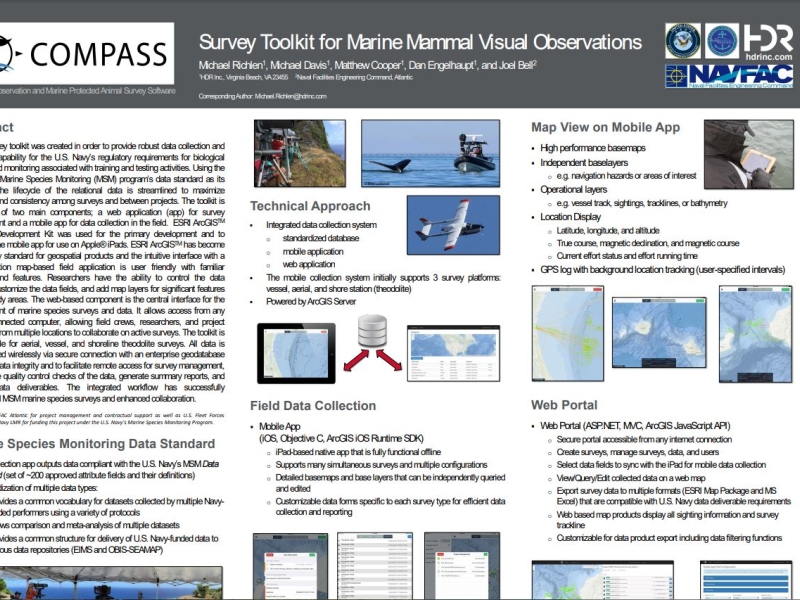
The United States (U.S.) Navy identified the need for development of a survey data-collection system that fully meets U.S. Navy Marine Species Monitoring (MSM) data standards. The objectives were to streamline data-collection procedures, minimize manual data-management requirements, and increase the standardization and repeatability of data-collection efforts. In response to this need, HDR developed a survey toolkit called COMPASS (Cetacean Observation and Marine Protected Animal Survey Software)
- 1,373.69 KB
More details
Collapse details
Date Published:
Filesize:
- March 1, 2017
The United States (U.S.) Navy identified the need for development of a survey data-collection system that fully meets U.S. Navy Marine Species Monitoring (MSM) data standards. The objectives were to streamline data-collection procedures, minimize manual data-management requirements, and increase the standardization and repeatability of data-collection efforts. In response to this need, HDR developed a survey toolkit called COMPASS (Cetacean Observation and Marine Protected Animal Survey Software). COMPASS is designed to be an integrated survey data-collection and data-management system to facilitate work conducted during MSM surveys. HDR’s fin survey toolkit integrates current mobile and web technologies to allow efficient real-time collection, processing, reporting, and delivery of marine species data. The final product will include a mobile platform for data collection in the field; a web portal to design, plan, and execute surveys and access data products; and a server-hosted databasemanagement system for quality control (QC), team collaboration, and preliminary data processing/reporting.
- 449.08 KB
More details
Collapse details
Date Published:
Filesize:
- August 1, 2016
The Navy has identified the need to develop a survey data collection platform based on the standardized Navy Marine Species Monitoring (MSM) program data standards. The platform needs to streamline collection scenarios, minimize manual data management requirements, facilitate QA/QC and reporting, and ensure consistency of data collection across the program. In response to this need, and in collaboration with the Navy Living Marine Resources program, fin (no associated acronym) is intended to be an integrated survey data collection and data management system to facilitate work conducted during marine species surveys. The final product will include a mobile platform for data collection, a web portal to set up surveys and access data products, and a server database management system.
- 541.69 KB
More details
Collapse details
Date Published:
Filesize:
- May 31, 2015
To protect cetaceans from negative impacts of seismic exploration and to make the best management decisions possible, we need to know where they are and when they’re there. Systematic line-transect surveys are typically used to provide this information, which is especially important at smaller spatial scales, such as the Mid- and South Atlantic planning areas that likely exhibit seasonal or inter-annual variability in species occurrence. The objectives of my project, therefore, were to identify gaps in space and time of cetacean survey effort and to inform BOEM of the needs for additional survey effort.
- 1,413.25 KB
Society for Mexican Marine Mammalogy, May 2023, Manzanillo, Mexico .
More details
Collapse details
Date Published:
- May 1, 2023
More details
Collapse details
Date Published:
Filesize:
- January 27, 2016
Naval Facilities Engineering and Expeditionary Warfare Center (NAVFAC EXWC) was tasked with conducting a thorough investigation and analysis of a passive acoustic data set recorded off Oahu (Hawaii) from 2010-2013. Passive ecological acoustic recorders (EARs) were deployed in waters adjacent to the Puuloa Underwater Detonation Range off the coast of Oahu from 2010-2013. Findings of note include: Of the over 133,000 files analyzed manually, approximately 850 contained odontocete whistles (0.6%); The low number of whistle detections is consistent with relationships between the coastal shelf bathymetry and odontocete foraging behavior established in similar studies in various locations in the main Hawaiian Islands; and Regulation detonation training in this area has a low chance of detrimental effects to transiting odontocetes.
- 1,992.50 KB
Marine mammal monitoring during Navy explosives training events off the coast of Virginia Beach, Virginia.
21st Biennial Conference on the Biology of Marine Mammals .
More details
Collapse details
Date Published:
Filesize:
- December 13, 2015
Navy training events involving the use of explosives pose a potential impact to marine mammals. This study used passive acoustic and visual monitoring data to evaluate marine mammals' behavioral responses to noise from explosive events. Monitoring was conducted during five training events in the Virginia Capes (VACAPES) Range Complex during August - October of 2009-2013. Passive acoustic monitoring methods ranged from a single hydrophone to an array of sonobuoys monitored in real time.
- 91.07 KB
Focusing on behavioral data gathering and analysis: Highlighting video capabilities from the air or shore.
Southern California Marine Mammal Workshop 2014 .
More details
Collapse details
Date Published:
Filesize:
- January 31, 2014
Powerpoint presentation made during panel session on Basic Behavioral Research: Techniques and Analyses held on 31 January 2014, Southern California Marine Mammal Workshop 2014.
- 2,932.41 KB
Where’s Whaledo: A software toolkit for array localization of animal vocalizations.
PLoS Computational Biology. 2024.
20:e1011456
More details
Collapse details
Date Published:
Publication:Ocean:Region:Methods:
- May 20, 2024
Where’s Whaledo is a software toolkit that uses a combination of automated processes and user interfaces to greatly accelerate the process of reconstructing animal tracks from arrays of passive acoustic recording devices. Passive acoustic localization is a non-invasive yet powerful way to contribute to species conservation. By tracking animals through their acoustic signals, important information on diving patterns, movement behavior, habitat use, and feeding dynamics can be obtained. This method is useful for helping to understand habitat use, observe behavioral responses to noise, and develop potential mitigation strategies. Animal tracking using passive acoustic localization requires an acoustic array to detect signals of interest, associate detections on various receivers, and estimate the most likely source location by using the time difference of arrival (TDOA) of sounds on multiple receivers. Where’s Whaledo combines data from two small-aperture volumetric arrays and a variable number of individual receivers
More details
Collapse details
Date Published:
Filesize:
- June 9, 2014
In September 2012 a team from the University of Washington, joined by personnel from Naval Facilities Engineering Command (NAVFAC) Atlantic and HDR, Inc., conducted a set of measurements of the underwater sound generated by sub-surface explosions from mine warfare exercise (MINEX) activities. In total five tests were conducted with explosive charges ranging from 0.1 to 6.0 kilograms of TNT-equivalent. The primary metrics used to quantify the sound from underwater explosions are the peak pressure generated by the explosion and the sound exposure level (𝑆𝐸𝐿). Three key findings emerged from this study: 1. The measured peak pressures were compared to the semi-empirical equation involving the scaling parameter R/W1/3, or the range from the explosive source divided by weight to the one-third power, where 𝑃𝑝𝑒𝑎𝑘 is the peak pressure in pascals (Pa), 𝑅 is the measurement range in meters, and 𝑊 is the charge weight in kilograms of TNT. 𝑃𝑝𝑒𝑎𝑘=52.4×10⁶𝑅𝑊1/3−1.13 The scaling parameter is also referred to as scaled range and measurements were found to be in very good agreement with the peak pressure equation over values of scaled range going from 200 to 2,000, as expressed in meter-kilograms-sec units. 2. Using the 90 percent energy approach, the sound exposure level (SEL) for the five tests were 174–190.4 𝑑𝐵 𝑟𝑒 1𝜇𝑃𝑎2𝑠. These results were found to be highly dependent on charge weight and range from the source, and it was determined that SEL was also well predicted using a modification of scaled range that involves an additional factor of 𝑊1/3, which arises from a semi-empirical equation for the energy flux density. The SEL is a measure of the total acoustic energy received by an organism, and is a common metric used in environmental acoustics as it allows for the comparison of sounds of varying duration. 3. Finally, measurements of Scholte interface waves were recorded during two of the tests. The extremely low-frequency (less than 10 Hertz) Scholte wave necessitated a precise correction for the effect of resistance and capacitance in the hydrophone and receiving network. The Scholte waves arrived between 1 and 4 s after the direct water arrival. Based on these arrival times, the shear speed in the sediment was estimated to be in the range of 100–370 𝑚/𝑠. Preliminary modeling using the wavenumber integration approach confirmed that the measured signal was a Scholte wave, and the estimate of sediment shear speed is a reasonable estimate. The Scholte wave is of relatively high amplitude for this frequency range (2-5 Hertz).
- 1,460.29 KB
More details
Collapse details
Date Published:
Filesize:
- January 14, 2015
On 13 and 14 May 2014, a team from the University of Washington conducted a set of measurements of the underwater sound generated by explosive charges as part of a naval training event conducted in the Silver Strand Training Complex off San Diego. Environmental measurements to support the acoustic research included measurements of sound speed versus depth showing a thermocline, and sea surface directional wave measurements. This team was joined by personnel from U.S. Pacific Fleet and HDR Inc., who conducted simultaneous observations of marine mammals.
- 2,104.68 KB
More details
Collapse details
Date Published:
Filesize:
- August 1, 2014
Naval activities such as ordnance disposal, demolition and requisite training, can involve detonation of small explosive charges in shallow water that have the potential to harm nearby marine life. Measurements of the underwater sound generated by sub-surface explosions were collected as part of a naval training exercise. In this thesis the noise levels from these explosions will be investigated using peak pressure, sound exposure level and energy spectral density. Measurements of very-low frequeny Scholte interface waves will also be presented and used to investigate elastic parameters in the sediment.
- 10,663.43 KB
Peak sound pressure and sound exposure level from underwater explosions in shallow water.
Journal of the Acoustical Society of America. 2014.
136 (3): EL218–EL223
More details
Collapse details
Date Published:
Publication:Ocean:Region:
- August 11, 2014
Experimental measurements of the peak pressure and sound exposure level (SEL) from underwater explosions collected 7 km off the coast of Virginia Beach, Virginia are presented. The peak pressures are compared to results from previous studies and a semi-empirical equation that is a function of measurement range and charge weight, and are found to be in good agreement. An empirical equation for SEL that similarly employs a scaling approach involving charge weight and range is also presented and shows promise for the prediction of SEL in shallow water.
Measurements of the peak pressure and sound exposure level from underwater explosions..
166th Meeting: Acoustical Society of America .
More details
Collapse details
Date Published:
Filesize:
- November 1, 2013
Naval activities such as ordinance disposal, demolition, and requisite training, can involve detonation of small explosive charges in shallow water. This work presents measurements of underwater sound from explosions in shallow water (depth order 10 m) during a naval training exercise with focus on peak pressures, sound exposure levels, and time series analysis. The peak pressures are compared to semi-empirical equations of scaled range, and the influence of elastic properties in the seabed are investigated. The ultimate goal of this work is to provide both accurate ground truth data, and improved modeling of such sound, to minimize impact on marine life.
- 883.64 KB
Modeling explosion generated Scholte waves in sandy sediments with power law dependent shear wave speed.
Journal of the Acoustical Society of America. 2015.
138:EL370-EL374
More details
Collapse details
Date Published:
Publication:Ocean:Region:
- October 9, 2015
Experimental measurements of Scholte waves from underwater explosions collected off the coast of Virginia Beach, VA in shallow water are presented. It is shown here that the dispersion of these explosion-generated Scholte waves traveling in the sandy seabed can be modeled using a power-law dependent shear wave speed profile and an empirical source model that determines the pressure time-series at 1 m from the source as a function of TNT-equivalent charge weight.
More details
Collapse details
Date Published:
Filesize:
- June 1, 2018
The Atlantic-BRS project (supported by U.S. Fleet Forces Command under the Navy’s marine species monitoring program) was conceived, designed, and initiated through a collaboration of researchers involved in several of these previous studies and in previous baseline marine mammal monitoring of key species including (Cuvier’s beaked whales (Ziphius cavirostris) and short-finned pilot whales (Globicephala macrorhynchus) off Cape Hatteras, NC.
- 6,246.70 KB
More details
Collapse details
Date Published:
Filesize:
- July 1, 2019
The Atlantic-BRS project (supported by U.S. Fleet Forces Command under the Navy’s marine species monitoring program) was conceived, designed, and initiated through a collaboration of researchers involved in several of these previous studies and in previous baseline marine mammal monitoring of key species including (Cuvier’s beaked whales (Ziphius cavirostris) and short-finned pilot whales (Globicephala macrorhynchus) off Cape Hatteras, NC.
- 12,793.01 KB
More details
Collapse details
Date Published:
Filesize:
- May 1, 2020
The Atlantic-BRS project (supported by U.S. Fleet Forces Command under the Navy’s marine species monitoring program) was conceived, designed, and initiated through a collaboration of researchers involved in several of these previous studies and in previous baseline marine mammal monitoring of key species including (Cuvier’s beaked whales (Ziphius cavirostris) and short-finned pilot whales (Globicephala macrorhynchus) off Cape Hatteras, NC.
- 4,933.59 KB
More details
Collapse details
Date Published:
Filesize:
- March 1, 2021
The Atlantic-BRS project (supported by U.S. Fleet Forces Command under the Navy’s marine species monitoring program) was conceived, designed, and initiated through a collaboration of researchers involved in several of these previous studies and in previous baseline marine mammal monitoring of key species including (Cuvier’s beaked whales (Ziphius cavirostris) and short-finned pilot whales (Globicephala macrorhynchus) off Cape Hatteras, NC.
- 3,950.13 KB
More details
Collapse details
Date Published:
Filesize:
- June 1, 2022
The Atlantic-BRS project (supported by U.S. Fleet Forces Command under the Navy’s marine species monitoring program) was conceived, designed, and initiated through a collaboration of researchers involved in several of these previous studies and in previous baseline marine mammal monitoring of key species including (Cuvier’s beaked whales (Ziphius cavirostris) and short-finned pilot whales (Globicephala macrorhynchus) off Cape Hatteras, NC.
- 6,130.30 KB
More details
Collapse details
Date Published:
Filesize:
- June 1, 2023
The Atlantic-BRS project (supported by U.S. Fleet Forces Command under the Navy’s marine species monitoring program) was conceived, designed, and initiated through a collaboration of researchers involved in several of these previous studies and in previous baseline marine mammal monitoring of key species including (Cuvier’s beaked whales (Ziphius cavirostris) and short-finned pilot whales (Globicephala macrorhynchus) off Cape Hatteras, NC.
- 2,585.88 KB
More details
Collapse details
Date Published:
Filesize:
- May 24, 2011
Scientific diving teams surveyed the benthic community in the turning basin and surrounding shoals in Apra Harbor, Guam to support analysis of potential impacts from constructing a proposed large vessel wharf in the Outer Harbor. A total of 72 locations were surveyed. Bottom substrates ranged from a nearly 100% cover of living coral structures to fine silty/sandcovered bottom. The sites included high percent cover of coral communities dominated by a Porites rus and Porites horizontalata complex, mixed coral communities with higher diversity coral and sponge assemblages, areas of relatively dense macroalgae, depauperate silty-sand bottom areas, and various combinations of these habitats.
- 9,739.68 KB
Streamlining High-Volume Data Acquisition, Analysis and Tracking of Marine Mammals with Highly Configurable, Standards-based Software.
27th Conference of the European Cetacean Society .
More details
Collapse details
Date Published:
Filesize:
- April 8, 2013
To meet the need for all-in-one, user-configurable, user-friendly combined survey/behavioral data collection and analysis software, the Mysticetus Observation Platform (Mysticetus) has been designed, tested and field deployed in numerous aerial, vessel and shore-based surveys for marine mammals around the world. Mysticetus provides real-time distance and bearing to a sighting by synthesizing real-time Global Positioning System (GPS) data with the declination angles (converted to distance) and times of sightings. This feature has been critical to quickly relocating sightings, particularly in higher Beaufort conditions. Relative location of the sighting to the aircraft/vessel is continuously displayed on a map on a laptop, and automatically adapts to changing distances and headings of the platform. Real-time bathymetric data are displayed, and can be used to determine numerous sea-floor characteristics in the survey area (e.g., depth, slope, aspect). Mysticetus also triangulates, in real-time, directional acoustic data received via radio from sonobuoys, allowing correlation of behavior with vocalizations, both in the field and during post-processing. Other post-survey analysis tools include automated tabular summaries of effort and sightings, Google Earth 3-D track display, distance-to-shore calculations, etc., that greatly reduce data, GIS and analysis efforts. Mysticetus is unique from other available similar software because it is easily configured by the user to select data fields/types, units, etc., and can record, summarize, analyze and plot data as indicated by the user.
- 639.51 KB
More details
Collapse details
Date Published:
Ocean:Region:Methods:
- January 1, 2025
Characterizing Behavior Distribution Salmonids Whales Offshore Marine Waters Washington
More details
Collapse details
Date Published:
Ocean:Region:Methods:
- January 1, 2023
In spring/summer of 2018 and 2021, the Pacific Islands Fisheries Science Center Cetacean Research Program deployed drifting acoustic recorders in the U.S. Exclusive Economic Zones surrounding the Mariana Archipelago. Manual assessments revealed a low-frequency (median 473-554 Hz), short-duration (median 0.596 s), stereotypic tonal nocturnal call throughout the Mariana Archipelago. Based on time of year, spatiotemporal patterns, clear division among calls (i.e., no chorusing), comparisons with known vocalizations of whales, turtles, and fish, and presence of Bryde's whale calls, and because the call has not been detected elsewhere, we hypothesize this 500-Hz pulsed call is produced by Bryde's whales (Balaenoptera brydei).
Influences of Seasonality and Oceanographic Features on the Habitat Use of Seabirds in Onslow Bay, NC.
33rd Annual Waterbird Society Meeting .
More details
Collapse details
Date Published:
- November 4, 2009
- 1,176.87 KB
Combining remote sensing and in situ measurements to study biophysical interactions in Gulf Stream fronts and eddies.
2010 Ocean Sciences Meeting .
More details
Collapse details
Date Published:
Filesize:
- March 1, 2010
aging opportunities for upper trophic level predators, particularly in oligotrophic regions. However, few studies have explicitly examined the biophysical mechanisms that enhance foraging opportunities for top predators in these features. We studied Gulf Stream Frontal Eddies (GSFEs), which interact with the coastal shelf off the coast of North Carolina. In particular, we investigated the oceanographic dynamics and prey distributions within GSFEs and the Gulf Stream front at a fine scale, and related these findings to the distribution of seabirds at a larger temporal and spatial scale using remotely sensed data. We conducted boat-based seabird surveys between June 2007 and September 2009. We assessed the distribution of potential seabird prey using 38 kHz and 120 kHz Simrad transducers and measured current regimes using a 300 kHz Acoustic Doppler Current Profiler (ADCP) during the summer and fall of 2009. Finally, we used satellite images of sea surface temperature to examine the distribution of seabirds in relation to broader-scale oceanographic features. GSFEs and the Gulf Stream front were important foraging areas for pelagic seabirds, but seabird species differed in their use of oceanographic habitats. We found differences in the distribution and dispersion of prey in Gulf Stream, eddy and coastal waters and discuss these differences in relation to the distribution and foraging strategies of the seabirds that exploit these features. Our findings directly link the existence of meso-scale oceanographic features to the prey and foraging ecology of upper trophic level marine predators.
- 35.77 KB
2010.
More details
Collapse details
Date Published:
Ocean:Region:
- June 1, 2010
PhD Dissertation Oceanographic features, such as fronts, eddies, and upwellings, provide important foraging areas for marine predators. These areas serve as important “hotspots” of marine life, by aggregating weakly swimming lower and mid-trophic level species which, in turn, attract foraging predators. Despite the importance of these dynamic features, we lack a comprehensive understanding of how they create foraging habitat for seabirds and other marine predators. In the first part of this dissertation, I review current knowledge of how seabirds use oceanographic features with an emphasis on developing a more mechanistic understanding of these features, and identify important considerations for future studies. I use the findings of this review to inform two field research projects in the Bay of Fundy, Canada and Onslow Bay, North Carolina. In these two projects, I examined seabird abundance and distribution in relation to oceanographic features that occur at different spatial and temporal scales. In the first project, I examined foraging habitat of red-necked phalaropes (Phalaropus lobatus) in relation fine-scale tidal forcing near the Brier Island ledges in the Bay of Fundy. This research demonstrated the importance of biophysical interactions in creating phalarope habitat, and characterized red-necked phalarope habitat in both space and time. In Onslow Bay, I investigated the effects of Gulf Stream fronts and eddies on the abundance and distribution of seabirds using both remotely sensed and in situ data. I used fisheries acoustics surveys to investigate prey distribution within Gulf Stream frontal eddies. I then developed habitat models for the six most commonly sighted species or species groups (Cory's shearwaters, Calonectris diomedea; greater shearwaters (Puffinus gravis; Wilson's storm-petrel, Oceanites oceanicus; Audubon's shearwaters, Puffinus lherminieri; black-capped petrels, Pterodrama hasitata; and red and red-necked phalaropes, grouped together as Phalaropus spp.) using multivariate modeling techniques. Gulf Stream frontal eddies influenced the abundance and distribution of seabirds in Onslow Bay, although frontal features were not as important in predicting seabird habitat as demonstrated in previous studies in the South Atlantic Bight. Prey availability in Gulf Stream frontal eddies was highest in eddy cold core regions, particularly in those regions close to the Gulf Stream. Taken together, the results of my dissertation: underscore the importance of conducting standardized surveys to assess dynamic environmental variables; demonstrate the use of multivariate methods to examine seabird foraging in relation to oceanographic features; emphasize the need to evaluate both prey distributions and physical regimes within oceanographic features at depth; and highlight the importance of temporal aspects of oceanographic features, such as the persistence and age of the features, when assessing the role that these features play in creating seabird foraging habitat.
Combining passive acoustics and satellite oceanography to evaluate cetacean habitat in the South Atlantic Bight.
2012 Ocean Sciences Meeting. .
More details
Collapse details
Date Published:
Filesize:
- February 20, 2012
In the South Atlantic Bight (SAB), the Gulf Stream (GS) front and Gulf Stream Frontal Eddies (GSFEs) are known to provide important habitat for foraging seabirds, but their effect on cetacean abundance and distribution has not been considered. Using data from moored High-frequency Acoustic Record Packages (HARPs) in Onslow Bay, we assessed the effects of dynamic oceanography on odontocete vocalization rates. Satellite images of sea surface temperature during HARP deployments were used to identify local water masses (Gulf Stream, shelf waters and Gulf Stream frontal eddies) relative to HARP locations for three HARP deployments, representing a total deployment time of 313 days (10/10/2007 – 01/16/2008; 04/24/2009 – 08/9/2009; and 11/8/2009 – 02/24/2010). Both the total duration of all vocal events and the total duration of click events, respectively, were analyzed for all odontocetes together, and also for sperm whales (Physeter macrocephalus), Risso’s dolphins (Grampus griseus), short-finned pilot whales (Globicephala macrorhynchus), and delphinids separately. T he presence of GSFEs and the location of the GS front influenced cetacean vocalization rates and we discuss these findings in relation to the ecology of the study species. (Abstract ID 12484)
- 35.06 KB
More details
Collapse details
Date Published:
Filesize:
- October 1, 2010
The monitoring plan and reporting for the HRC and other Navy ranges provides science-based answers to questions regarding whether or not marine mammals are exposed and reacting to Navy training. The study questions of the monitoring plan are to answer the following questions: 1. Are marine mammals and sea turtles exposed to MFAS at regulatory thresholds of harm or harassment? If so, at what levels and how frequently are they exposed? 2. If marine mammals and sea turtles are exposed to MFAS, do they redistribute geographically as a result of repeated exposure? If so, how long does the redistribution last? 3. If marine mammals and sea turtles are exposed to MFAS, what are their behavioral responses? Are they different at various levels? 4. What are the behavioral responses of marine mammals and sea turtles that are exposed to various levels and distances from explosives?
- 2,722.06 KB
More details
Collapse details
Date Published:
Filesize:
- August 12, 2011
In order to train with mid‐frequency active sonar (MFAS) and underwater explosives, the Navy has obtained a Letter of Authorization (permit) from the National Marine Fisheries Service (NMFS) under the Marine Mammal Protection Act and a Biological Opinion under the Endangered Species Act. The Hawaii Range Complex (HRC) Monitoring Plan was developed with NMFS to comply with the requirements under the permit. The monitoring plan and reporting will provide science‐based answers to questions regarding whether or not marine mammals are exposed and reacting to Navy MFAS.
- 1,280.54 KB
More details
Collapse details
Date Published:
Filesize:
- May 25, 2012
In order to train with mid-frequency active sonar (MFAS) and underwater explosives, the Navy has obtained from the National Marine Fisheries Service (NMFS) a permit under the Marine Mammal Protection Act and a Biological Opinion under the Endangered Species Act. The Hawaii Range Complex (HRC) Monitoring Plan was developed with NMFS to comply with the requirements under the permit. The monitoring plan and reporting will provide science-based answers to questions regarding whether or not marine mammals are exposed and reacting to Navy MFAS.
- 2,339.60 KB
More details
Collapse details
Date Published:
Filesize:
- July 1, 2023
Long-term high-frequency acoustic recording packages (HARPs) at eight sites along the western North Atlantic shelf break.
- 2,824.80 KB
Spatial Analysis of Beaked Whale Foraging During Two 12 kHz Multibeam Echosounder Surveys.
Frontiers in Marine Science. 2021.
8:654184
More details
Collapse details
Date Published:
Publication:Ocean:Region:Methods:
- August 24, 2021
To add to the growing information about the effect of multibeam echosounder (MBES) operation on marine mammals, a study was conducted to assess the spatial foraging effort of Cuvier’s beaked whales during two MBES surveys conducted in January of 2017 and 2019 off of San Clemente Island, California. The MBES surveys took place on the Southern California Antisubmarine Warfare Range (SOAR), which contains an array of 89 hydrophones covering an area of approximately 1800 km2 over which foraging beaked whales were detected. A spatial autocorrelation analysis of foraging effort was conducted using the Moran’s I (global) and the Getis-Ord Gi∗ (local) statistics, to understand the animals’ spatial use of the entire SOAR, as well as smaller areas, respectively, within the SOAR Before, During, and After the two MBES surveys.
More details
Collapse details
Date Published:
Filesize:
- December 4, 2022
The University of Hawaii Health and Stranding Lab located at Marine Corps Base Hawaii (MCBH) is the only entity in the Pacific Islands region that responds to strandings, conducts necropsy and cause of death investigations, archives tissues and performs research to identify and evaluate threats to Pacific Island cetaceans. The purpose of this project is to conduct analyses of historical stranding patterns and causes of mortality that incorporate quantitative estimates of stranding date, genetic identification of species when necessary and advanced diagnostic procedures, including evaluation of nutritional state to categorize past strandings as acute or chronic causes.
- 292.35 KB
More details
Collapse details
Date Published:
Filesize:
- June 20, 2023
The University of Hawaiʻi Health and Stranding Lab, located at Marine Corps Base Hawaiʻi (MCBH), is the only entity in the Pacific Islands region that responds to strandings, conducts necropsy and cause of death investigations, archives tissues and performs research to identify and evaluate threats to Pacific Island cetaceans. The purpose of this project is to conduct analyses of historical stranding patterns and causes of mortality that incorporate quantitative estimates of stranding dates, genetic identification of species when necessary, and advanced laboratory diagnostics.
- 432.11 KB
More details
Collapse details
Date Published:
Filesize:
- January 1, 2015
A new method was developed to provide better metrics for quantifying Mid-Frequency Active Sonar (MFAS) occurrence and levels, and was applied to passive acoustic monitoring data collected in the Southern California (SOCAL) Range Complex. MFAS signals are composed of both tones and frequency swept ‘pings’, often with multiple pings grouped closely in time as packets. These packets often occur repeatedly at intervals >20 s over periods of hours as wave train events with gaps between events >1 h. The new approach uses a higher received level packet detection threshold (130 dBpp re 1 µPa) than previous analyses, which limits the detection range to about 20 km, reducing the number of overall detections but also reducing the false detection rate.
- 1,335.30 KB
More details
Collapse details
Date Published:
Filesize:
- April 1, 2015
Low-frequency (10 – 1000 Hz) ambient noise spectrum level measurements were made at six sites over a period of about 7 years (2007 – 2014) offshore of North Carolina and Florida on the Atlantic seaboard continental shelf and slope. Site-averaged ambient spectrum levels for the six sites are similar (within 10 dB) with levels around 60-65 dB re 1µPa2/Hz near 1000 Hz, 70-75 dB re 1µPa2/Hz at 100 Hz, and ~85-95 dB re 1µPa2/Hz at 20 Hz. Instrument strumming, presumably from tidal and ocean current flow, affected five of the six sites, including a deep (~900 m) water site near the region where the Gulf Stream heads northeast offshore. The sixth site, the other deep (~950 m) water site, had minimal or no acoustic masking from flow induced strumming and showed spectrum levels similar to those of other deep water recordings, including whale call seasonality, distance shipping, and correlation with wind events.
- 1,883.75 KB
More details
Collapse details
Date Published:
Filesize:
- March 1, 2020
Over the past decade, underwater explosive sounds have been recorded in the U.S. Navy’s Southern California Range Complex. The majority of these events are related to the use of seal bombs by the fishing industry as a deterrent to depredation. In addition, a smaller number of explosions are from Navy ordnance use during training exercises, especially in the Southern California Anti-submarine Warfare (ASW) Range (SOAR).
- 4,040.90 KB
More details
Collapse details
Date Published:
Filesize:
- July 1, 2018
Underwater ambient and anthropogenic sounds were recorded over 5 years in the U.S. Navy’s Southern California Range Complex, at three sites ranging from ~500 m to 1300 m deep from June 2012 to June 2017. This report summarizes low-frequency ambient soundscape and anthropogenic sounds from mid-frequency active sonar and explosions over the 5-year period. Long-term average ambient sound pressure levels were highest at the shallow near-shore site (P) and lowest at the site (H) in the western San Nicolas Basin, likely related to nearby vessel activity.
- 6,517.30 KB
Complete
Atlantic Marine Assessment Program for Protected Species (AMAPPS)
Project Objectives
Assess the abundance, distribution, ecology, and behavior of marine mammals, sea turtles, and seabirds in U.S. Atlantic EEZ
Complete
Baseline Monitoring for Marine Mammals in the East Coast Range Complexes (aerial surveys)
Project Objectives
Assess occurrence, habitat associations, and density of marine mammals and sea turtles in key areas of Navy range complexes
Complete
Baseline Monitoring for Marine Mammals in the East Coast Range Complexes (vessel surveys)
Project Objectives
Assess occurrence, habitat associations, and stock structure of marine mammals and sea turtles in key areas of Navy range complexes
Current
Coral survey at Farallon de Medinilla
Project Objectives
Assess presence and status of ESA-listed corals at FDM
Complete
Effectiveness of Navy Lookout Teams in Detecting Cetaceans
Project Objectives
Obtain data to characterize the potential exposure of marine mammals and ESA-listed marine species to Navy training and testing activities, evaluate the effectiveness of mitigation measures
Complete
Guadalupe Fur Seal Satellite Tracking
Project Objectives
Determine the at-sea distribution of endangered Guadalupe fur seals and whether they travel through or utilize the offshore waters of the Southern California Range Complex and Northwest Training and Testing area
Complete
Mid-Atlantic Autonomous Passive Acoustic Monitoring
Project Objectives
Monitor large whale occurrence in the mid-Atlantic
Current
North Pacific Marine Mammal Species Distribution
Project Objectives
Develop a North Pacific-wide species distribution model for cetaceans
Current
Pacific Islands Comprehensive Stranding Investigations
Project Objectives
Conduct comprehensive investigations of stranded marine mammals throughout the Pacific Islands with emphasis on the Hawaiian and Mariana Island chains. This includes conducting necropsies of stranded animals, collecting and archiving samples, conducting disease screening, genetic testing, and analysis of historical data. The objective is to examine stranding patterns and causes of death for marine mammals in the Pacific Islands.
Complete
Sound source measurements from pile driving
Project Objectives
Determine the source levels produced by impact and vibratory driving of different size and material piles during construction projects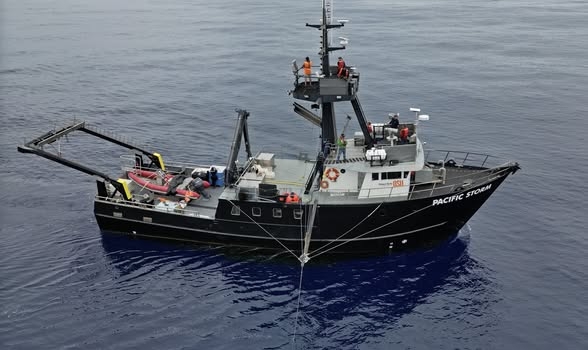
Mesoplodon mysterioso
June 13, 2024
We are thrilled to be part of the "Mystery Mesoplodon Expedition" off the west coast of Baja California searching for an elusive new species of beaked whale. Read about the initial discovery and stay tuned for updates on this exciting expedition!